Agentic AI in banking means software that works a task end-to-end — investigating a fraud alert, closing a KYC case, moving a loan toward a decision — rather than just scoring or flagging it. It is the applied form of the broader pattern described in agentic AI in financial services, narrowed to the workflows that run a bank. The opportunity is large, and so is the governance burden, because these systems act on regulated decisions.
Where banks are applying it
- Fraud detection and investigation. Beyond real-time scoring, agents gather evidence across systems, assemble a case, and route it — compressing investigation time and freeing analysts for the genuinely ambiguous alerts.
- AML / KYC. Alert triage, transaction screening, and case closure are among the most cited early wins: agents handle the high-volume, low-risk alerts so compliance staff focus on real risk.
- Credit underwriting and loan processing. Document extraction, bureau pulls, policy checks, and draft credit memos shorten turnaround — McKinsey describes the shift as staff moving from rule-based execution to judgment and engagement. Consumer credit decisions must stay explainable.
- Reconciliation and operations. Matching transactions across systems at scale, with exceptions escalated to a human.
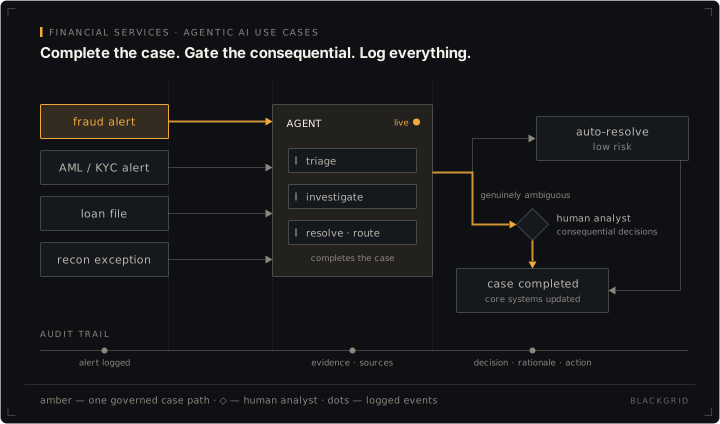
Why "it acts" changes everything
A generative assistant that drafts a memo is reviewed before anything happens. An agent that processes a loan or closes an alert is doing the thing. That is the difference covered in agentic AI vs. generative AI: a wrong answer is an inconvenience; a wrong action is an incident. Retrieval quality matters too — most banking agents ground their reasoning in current policy and customer data via agentic RAG rather than stale model weights.
The governance reality
This is where banking projects stall. US model-risk guidance was revised in 2026 (OCC 2026-13 / SR 26-02) and explicitly places generative and agentic AI outside its scope, leaving banks to govern these systems with voluntary frameworks (NIST AI RMF, ISO/IEC 42001, the US Treasury Financial Services AI RMF — see model risk management for agentic AI) and existing law such as CFPB adverse-action requirements. Gartner projects that more than 40% of agentic AI projects will be canceled by the end of 2027 — usually for escalating costs, unclear value, or inadequate controls. The deployments that survive pair real use cases with explainability, human-in-the-loop checkpoints, and audit trails. The full governance picture lives in the agentic AI in financial services pillar.
Treat any specific regulatory detail above as a starting point and confirm the current position with your model-risk and compliance teams before relying on it.
How to sequence a banking rollout
The banks that get past the pilot stage tend to follow the same sequence, rather than chasing the most autonomous use case first.
- Start where a human already reviews every case. AML alert triage and fraud investigation are favorites because the agent assists a reviewer, so an error is caught before it becomes an incident.
- Prove the agent against the human baseline. Run it in parallel, measure agreement and the quality of its evidence-gathering, and only let it act once the evaluation data supports it.
- Instrument before you automate. The audit trail, the human-in-the-loop checkpoints, and the rollback path are day-one deliverables, not retrofits.
- Widen autonomy by exception, not by default. Expand the band of cases the agent closes on its own slowly, and keep the consequential decisions — large exposures, adverse actions, account freezes — with a person.
Customer-service agents sit earlier on this curve: they are widely piloted, but taking real backend actions — moving money, changing a record — pulls them into the same governance regime as the high-value workflows above. The sequencing is the strategy.
Putting an agent into a regulated banking workflow you can stand behind is mostly a governance and integration problem, not a model problem. The banks pulling ahead are not the ones with the flashiest model — they are the ones that treat governance and integration as the product, not the paperwork. See how that looks in the BlackGrid solution for banking — or talk to BlackGrid about doing it safely.