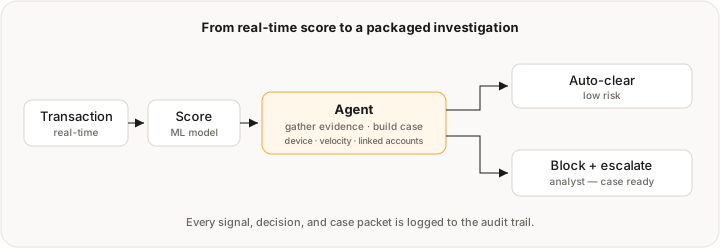
Agentic AI for fraud detection is the shift from scoring a transaction to investigating it. A conventional system flags risk; an agentic system gathers the evidence around the flag, assembles an investigation case, and then either clears a low-risk alert or escalates a high-risk one to an analyst with the context already compiled. The score was never the hard part — the investigation is — and that is exactly where agents add leverage. This is one of the most mature applied use cases described in agentic AI in banking.
Scoring was never the bottleneck
Banks have used machine-learning fraud scores for years. The cost center is what happens after a score fires: an analyst pulls device fingerprints, checks velocity, traces linked accounts, reads prior dispositions, and reconstructs a story — most of it manual data retrieval before any judgment is applied. False positives dominate, so analysts spend the bulk of their time clearing alerts that were never fraud.
Agentic AI attacks that step. Given a flagged transaction, the agent gathers corroborating evidence across systems, cross-references related transactions and claimants, and builds a structured case. For clearly low-risk patterns it documents a closure rationale; for high-risk ones it blocks or holds per policy and routes the packaged case to an analyst. McKinsey describes this as staff moving from rule-based execution toward judgment — the agent assembles, the human decides.
Why fraud is a strong first deployment
Fraud detection scores well on the criteria that make an agentic project succeed: the volume is high, the inputs are messy, and a human reviewer is already in the loop. The agent assists an existing review rather than replacing a decision, which keeps the blast radius contained while the system earns trust. That matters, because Gartner predicts more than 40% of agentic AI projects will be canceled by the end of 2027 — usually for unclear value or inadequate controls, both of which a well-scoped fraud deployment avoids.
The score and the agent work together
Agentic fraud detection does not throw away the bank's fraud models — it consumes them. The machine-learning score remains the fast first filter that decides what is worth looking at; the agent is what turns a score into a resolved case. The two improve each other: the agent's enrichment adds context a point-in-time score lacks — Is this device new to the customer? Does the counterparty appear in related cases? — so more borderline alerts are resolved correctly instead of being dumped on an analyst as a false positive. Over time, the dispositions the agent and analyst produce become labeled data that sharpens the next generation of the score. The design goal is a loop — detect, investigate, resolve, learn — not a single model doing everything. That loop is also where evaluation lives: tracking false-positive and false-negative rates as fraud patterns shift is what keeps the system honest.
The controls that make it deployable
Fraud detection acts on customers, so it inherits the full governance burden:
- Audit trail. Every signal consulted, every action taken, and every closure rationale must be logged and reconstructable — the backbone of any defensible AI agent audit trail.
- Human-in-the-loop. High-impact actions such as freezing an account route through a human checkpoint, not full autonomy.
- Evaluation and monitoring. False-positive and false-negative rates are tracked over time, because fraud patterns drift and so do agents.
- Fairness and law. The EU AI Act carves fraud detection out of its high-risk creditworthiness category, but anti-discrimination and data-protection law still apply; in the US, OCC 2026-13 / SR 26-02 places agentic AI outside existing model-risk scope, so governance leans on other frameworks and existing law.
Fraud detection and the closely related AML and KYC workflows are where most banks first put agents into financial-crime operations. The pattern — assist the analyst, log everything, escalate the consequential — is the template for the broader program in agentic AI in financial services.
Talk to BlackGrid about deploying agentic fraud detection you can defend to an examiner.