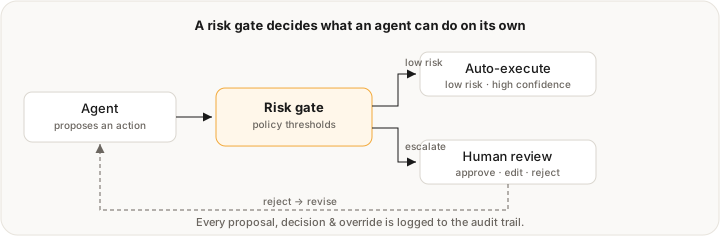
Human-in-the-loop (HITL) AI is a design in which a person reviews, approves, or can override an agent's consequential actions, rather than letting it act on its own every time. In practice it is a risk gate: the agent proposes an action with a confidence signal, low-risk and high-confidence actions execute automatically, and high-risk or low-confidence ones route to a human to approve, edit, or reject. It is the single most important control for putting agents into workflows where a wrong action is an incident, not an inconvenience.
Why agents need a gate that earlier AI did not
A generative assistant that drafts a memo is reviewed before anything happens — the human is structurally in the loop. An agent that moves a payment, closes a case, or declines an application is doing the thing. The act is the output. That is why autonomy and oversight have to be designed together: the more an agent can do without a person, the more precisely you must define what it may not do without one.
Designing the risk gate
A useful gate is driven by policy, not vibes. Three inputs decide where the threshold sits:
- Impact — the cost and blast radius if the action is wrong.
- Reversibility — whether a mistake can be undone, and how easily.
- Confidence — the agent's own signal, calibrated against evaluation data rather than taken at face value.
High-impact, irreversible, or low-confidence actions escalate; the high-volume, low-risk remainder flows through. Crucially, the gate is not static: as evaluation builds evidence that the agent handles a class of cases reliably, you can widen what executes automatically — and tighten it the moment monitoring says otherwise.
In-the-loop vs on-the-loop
The terms are not interchangeable. Human-in-the-loop means a person acts within the decision — approval is required before execution. Human-on-the-loop means a person supervises and can intervene, but the system acts by default. Lower-stakes, high-volume work may justify on-the-loop; consequential, regulated decisions generally demand in-the-loop, where a named human owns the outcome.
Design for the reviewer, not just the gate
A risk gate is only as good as the human behind it, and the fastest way to ruin one is to overwhelm the reviewer. If every borderline action lands in a queue with no context, people rubber-stamp — automation bias sets in and the checkpoint becomes theater. A workable gate gives the reviewer exactly what they need to decide: what the agent proposes, why, the evidence behind it, and the consequence of approving. It makes rejecting or editing as easy as approving, routes the right cases to the right expertise, and records what the reviewer saw at decision time for the audit trail. Oversight that people can actually exercise is the goal — not a button that always gets pressed.
The regulatory backbone
Human oversight is not only good engineering; in many cases it is the law. GDPR Article 22 gives individuals the right not to be subject to decisions based solely on automated processing where those decisions have legal or similarly significant effects — and requires a route to human intervention. The NIST AI Risk Management Framework builds human oversight into its Govern and Manage functions. And in US banking, the revised model-risk guidance — OCC Bulletin 2026-13 / SR 26-02 — places generative and agentic AI outside its existing scope, leaving human accountability as a load-bearing control while dedicated rules are written. McKinsey frames 2026 as the shift to the agentic era with trust as the gating factor — and a credible human checkpoint is how institutions earn that trust.
It is not anti-automation — it is how automation scales
The objection that a human in the loop defeats the purpose misreads the goal. You are not asking a person to review everything; you are automating the routine majority and concentrating scarce human judgment on the consequential minority. That is exactly the discipline behind a defensible audit trail, explainable lending decisions, and the model-risk controls in model risk management for agentic AI — and it is what makes agentic AI in banking deployable rather than merely demonstrable.
Designing the gate — and the escalation, logging, and override paths around it — is most of the work of making an agent safe to deploy. Talk to BlackGrid about getting it right.