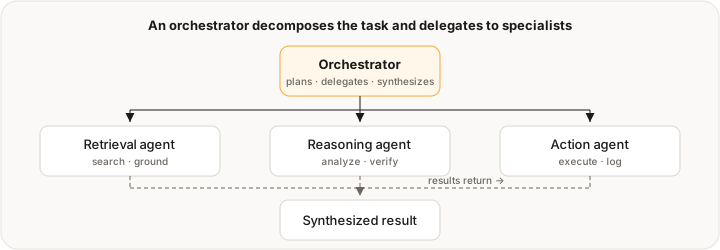
Multi-agent orchestration is the coordination of several specialized AI agents to complete a task that is too broad or varied for one. The common shape is an orchestrator that decomposes the task, delegates subtasks to worker agents, and synthesizes their outputs into a single result. It is powerful — and frequently the wrong first choice. Anthropic's Building Effective Agents makes the point bluntly: find the simplest solution that works, and only add complexity — more agents, more autonomy — when it demonstrably improves the outcome.
The patterns, simplest first
The same guide lays out a ladder of patterns, from least to most autonomous:
- Prompt chaining — break a task into a fixed sequence of steps, each feeding the next.
- Routing — classify the input and send it to the right specialized path.
- Parallelization — run subtasks at the same time and aggregate, for speed or for voting.
- Orchestrator-workers — a central model dynamically decomposes the task and delegates to workers, then combines their results.
- Evaluator-optimizer — one agent produces, another critiques, and the loop repeats until a bar is met.
The first three are workflows: systems where the steps are predefined. The last two edge toward agents: systems where the model directs its own process and tool use. The distinction matters because each rung up the ladder buys flexibility at the cost of predictability.
Orchestrator-workers in practice
Orchestrator-workers fits tasks whose shape is not known in advance — where you cannot pre-script the subtasks because they depend on the input. The orchestrator reads the task, decides what needs doing, spins up workers with the right tools and context for each piece, and assembles the result. Each worker typically reaches its own tools and data over a shared layer such as the Model Context Protocol, so adding a capability means adding a tool, not rewiring the system. Many production systems also give a worker its own grounded retrieval through agentic RAG rather than relying on a single shared context window.
The cost of coordination
Every agent you add multiplies tokens, latency, and failure modes, and makes the system harder to debug. This is not a hypothetical tax. Gartner predicts that more than 40% of agentic AI projects will be canceled by the end of 2027 — commonly for escalating costs and unclear value, exactly the failure mode that over-engineered multi-agent designs invite.
So the engineering discipline is subtractive. Reach for multiple agents when a task has genuinely separable subtasks, needs different tools per step, or benefits from parallel exploration. If a single well-equipped agent does the job, that is the better system — fewer moving parts, lower cost, easier to evaluate. See single-agent vs multi-agent for the decision in brief.
How agents share state
The hidden complexity in multi-agent systems is not the agents — it is what passes between them. An orchestrator has to hand each worker enough context to do its job, collect partial results, and reconcile them, and every hand-off is a place where information can be dropped, duplicated, or contradicted. Designs differ in how they manage this: some pass explicit messages, some share a common scratchpad or memory, some write to a shared store the orchestrator reads back. Whatever the mechanism, two questions decide whether it holds up — does each agent get the context it needs without drowning in irrelevant detail, and can two workers' actions conflict? In regulated workflows there is a third: is every hand-off logged, so the audit trail covers the whole system and not just one agent. Getting the plumbing of state right is most of what separates a robust orchestration from a fragile demo.
Make it provable, not just clever
A multi-agent system is only deployable if you can tell whether it works and keep a human over the consequential calls. That means measuring behavior — see how to evaluate AI agents — and routing high-impact actions through a human-in-the-loop checkpoint. In a regulated setting like agentic AI in financial services, those two disciplines are what separate an orchestration diagram from a production system.
Coordination is a means, not an end. Talk to BlackGrid about designing agent systems that are as simple as the problem allows — and no simpler.