Generative AI produces content in response to a prompt; agentic AI pursues a goal. A generative model answers, drafts, or summarizes when you ask it to. An agentic system decides what to do, calls tools, takes actions, observes the results, and adapts across multiple steps until a task is complete. The distinction is not academic — it is the difference between a system that answers and one that acts.
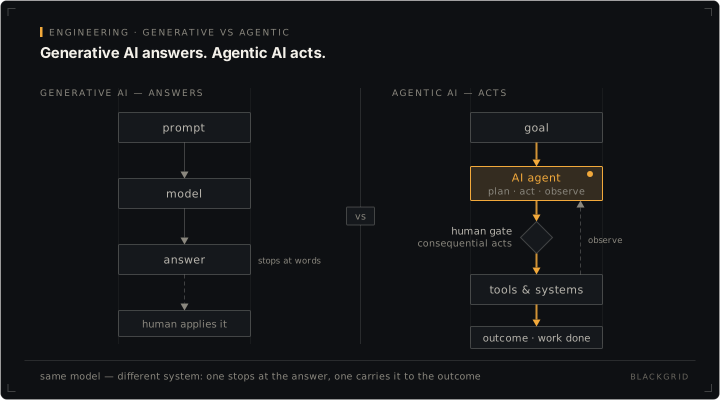
The core difference
| Generative AI | Agentic AI | |
|---|---|---|
| Core job | Produce content | Pursue a goal |
| Output | An answer | A completed task |
| Autonomy | Responds to prompts | Plans and acts across steps |
| Tools | Usually none | Calls tools, APIs, systems |
| Main risk | A wrong answer | A wrong action |
| Oversight | Review the output | Govern the actions |
This split — produce content versus pursue a goal — is the same one platform vendors like IBM draw. A closely related framing is chatbot vs AI agent.
Examples side by side
The distinction is clearest in concrete tasks. A generative system drafts a credit memo, summarizes a policy document, answers a customer's question, or proposes ten marketing subject lines — useful output that a person reviews and acts on. An agentic system takes the next step and does the work: it works an AML alert from triage to a documented closure, processes a claim from first notice of loss to a settlement recommendation, or moves a loan application through bureau pulls, policy checks, and a decision. The generative system hands you a draft; the agentic system hands you a completed — or escalated — case. In financial services that gap, between producing a document and completing a regulated workflow, is exactly where both the value and the risk live.
The same model, a different system
Agentic and generative AI are usually built on the same underlying models. What makes a system agentic is not a different model but the scaffolding around it: tools it can call, a loop that lets it act and observe the results, memory that carries state across steps, and a goal it is working toward. Strip that scaffolding away and an agent is a generative model again. This is why the line blurs in practice — adding tool use and a loop to a chatbot quietly turns it into an agent, and the governance requirements change the moment it can act.
Why the distinction matters now
The line is blurring fast. Gartner projects that 40% of enterprise applications will include task-specific AI agents by the end of 2026, up from under 5% in 2025. As generative features quietly become agentic, the stakes change with them: a wrong sentence is an inconvenience; a wrong action — a payment sent, a record changed, a customer declined — is an incident.
When to use each
- Reach for generative AI when a human stays in the loop and the output is reviewed before it matters: drafting, summarizing, classifying, answering questions.
- Reach for agentic AI when you want a multi-step workflow completed end-to-end — but only alongside the guardrails, human-in-the-loop checkpoints, and audit trails that acting (rather than answering) demands.
Why the difference changes your controls
The reason this taxonomy matters is operational, not academic. For generative AI, oversight means reviewing an output before it is used — the human is the last step. For agentic AI, the system can act before anyone reviews it, so oversight has to move inside the process: a human-in-the-loop gate on consequential actions, an audit trail of what it did, and evaluation of its decisions rather than just its prose. Answering safely is a content problem; acting safely is a governance one.
In practice, they work together
Most enterprise agents use a generative model as their reasoning engine, and retrieval is often part of the loop. When an agent decides what to look up and when, you get agentic RAG — which grounds the agent's reasoning in current data, building on the underlying retrieval-augmented generation pattern.
For regulated industries, the shift from generative to agentic is a shift from reviewing outputs to governing actions. Talk to BlackGrid about the controls that make that move safe.