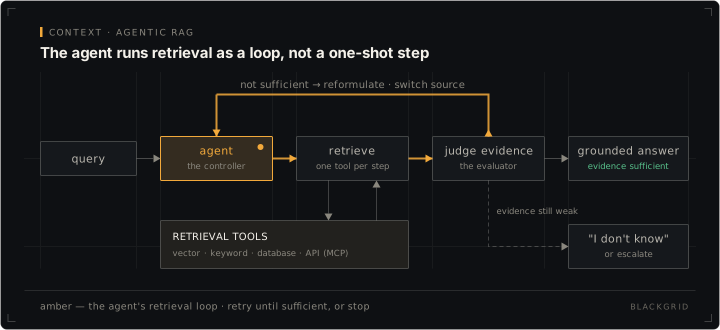
Agentic RAG is retrieval-augmented generation restructured as a control loop instead of a fixed pipeline. Where classic retrieval-augmented generation (Lewis et al., 2020) retrieves a set of passages once and then generates an answer, agentic RAG puts an agent in charge of retrieval: it decides whether to look something up, what to search for, which source to use, and whether the evidence it got back is good enough — looping until it is, or escalating when it is not.
From pipeline to control loop
Classic RAG is a straight line: embed the query, search a vector store, place the top passages in the prompt, generate. It works well for direct, single-hop questions. It struggles when a question needs several steps, draws on multiple systems, or when the first retrieval simply misses.
Agentic RAG replaces the straight line with a loop. The agent can:
- Decide whether to retrieve at all — some questions are answerable directly, and retrieving anyway adds noise.
- Reformulate the query — rephrase, decompose into sub-questions, or pivot to a different index.
- Judge the evidence — grade whether retrieved passages actually support an answer, and retry if they do not.
- Use multiple tools — combine vector search, keyword search, a database query, or an API call (often reached over the Model Context Protocol), choosing per step.
Common patterns
Three patterns recur in the research and in production systems:
- ReAct interleaves reasoning with actions (including retrieval), so the model thinks, acts, observes, and repeats.
- Self-RAG has the model critique its own need to retrieve and the quality of what it generated, deciding when more evidence is required.
- Corrective RAG grades retrieved passages and falls back to alternative sources when the primary results are weak.
What it costs
The loop is not free. Each extra reasoning or retrieval step adds latency, token cost, and more places for the system to go wrong. Agentic RAG earns its keep on hard, multi-step, multi-source questions — and on questions where being wrong is expensive, because the loop is where you enforce "retrieve more, or say you do not know." For simple lookups, standard RAG remains the cheaper, more predictable choice — see RAG vs agentic RAG for the decision side by side.
How to build an agentic RAG loop
In implementation terms, agentic RAG adds three things to a standard pipeline. First, a controller — the agent that decides, at each step, whether to retrieve, what to ask, and when to stop. Second, an evaluator that grades retrieved passages for relevance and sufficiency, so the loop has a signal to act on rather than blindly appending context. Third, stopping conditions — a budget on steps or tokens and a fallback ("if the evidence is still weak, say so or escalate") so the loop terminates instead of spinning. The retrieval layer underneath is usually unchanged: vector search, keyword search, and re-ranking, with the agent choosing among them and reaching other tools over a protocol like the Model Context Protocol. The hard parts are the evaluator and the stopping logic, because a loop that cannot tell good evidence from bad just spends more to be wrong.
Where it fits in a larger agent
Agentic RAG rarely stands alone. It is the grounding layer inside a bigger system: a single agent uses it to answer accurately, and in multi-agent orchestration a dedicated retrieval agent may own it entirely. Either way, the discipline that makes any agent deployable applies — measure it with real evaluation, and in regulated settings, log what was retrieved so a decision can be reconstructed.
Why it matters for regulated industries
In financial services, the agentic loop is also where governance lives. Grading evidence, logging which sources were used, and enforcing escalation when confidence is low are exactly the controls auditors and model-risk teams expect. Agentic RAG is rarely deployed alone — it is one component of broader agentic AI deployments in financial services and the use cases that run a bank, where retrieval quality and auditability decide whether a system is production-ready.
If you are designing an agentic system and need the retrieval layer to be both accurate and defensible, talk to BlackGrid.