Retrieval-augmented generation (RAG) is an architecture that connects a large language model (LLM) to an external knowledge source, retrieving relevant information at query time and supplying it to the model as context. Instead of relying only on what a model learned during training, a RAG system looks up the most relevant facts first, then generates an answer grounded in them.
The approach was introduced by Lewis et al. in 2020 and has become a default pattern for enterprise applications that need accurate, current, and source-attributable answers.
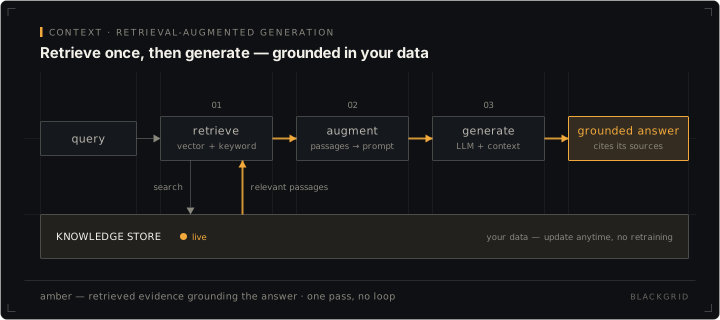
How RAG works
A RAG pipeline has three stages:
- Retrieve. The user's query is used to search a knowledge store — typically a vector database of document embeddings, often combined with keyword search — for the most relevant passages.
- Augment. Those passages are inserted into the model's prompt as context, alongside the original question.
- Generate. The LLM produces an answer conditioned on the retrieved context, ideally citing the sources it used.
Because the knowledge lives outside the model, you can update it continuously without retraining, and point the same model at different corpora for different use cases.
Why enterprises use RAG
- Grounding and accuracy. Answers reflect your actual documents, reducing — though not eliminating — hallucination.
- Freshness. Update the knowledge store and answers update immediately; no retraining cycle.
- Source attribution. Retrieved passages provide citations, which are essential for trust and compliance.
- Data governance. Proprietary data stays in your own store and is retrieved at query time rather than baked into model weights — an important property for regulated enterprises.
- Cost and iteration. Maintaining an index is typically cheaper and faster to iterate on than repeatedly fine-tuning a model.
RAG vs. fine-tuning
These are complementary techniques, not competitors — and both sit beneath the broader shift from generative to agentic AI.
| Dimension | RAG | Fine-tuning |
|---|---|---|
| Best for | Injecting knowledge | Shaping behavior / format |
| Data freshness | Real-time | Fixed at training |
| Citations | Native | Not inherent |
| Update cost | Low (re-index) | High (retrain) |
A common enterprise pattern is to fine-tune for tone and task structure while using RAG for the underlying facts. For a fuller side-by-side, see RAG vs fine-tuning and prompt engineering vs fine-tuning; if you are weighing retrieval against a large context window, see RAG vs long context.
Limits and considerations
RAG is powerful but not magic. Its output is only as good as its retrieval: if the right passage isn't found, the model can't use it. Production systems need attention to chunking (how documents are split), embedding quality, hybrid search (semantic plus keyword), re-ranking, and evaluation. Security matters too — access controls must be enforced at retrieval time so users only ever see what they are permitted to.
How RAG reduces hallucination — and when it doesn't
The headline benefit of RAG is fewer hallucinations, but it is worth being precise about why, and about the limits. Grounding helps because the model answers from retrieved evidence rather than parametric memory, so it is far less likely to invent a fact that is not in front of it. It is not a guarantee. RAG still fails when retrieval misses the relevant passage (the model answers from memory anyway), when sources conflict and it picks wrong, or when it over-generalizes beyond what the passage actually says. The mitigations are practical: require citations so a human can check the basis for an answer; design the system to say "I don't know" when the evidence is weak rather than guess; and evaluate faithfulness — does the answer actually follow from the retrieved text — not just fluency. In regulated settings, that last property — faithfulness you can audit — is the whole point.
For enterprises moving from pilot to production, the hard part is rarely the demo; it is the retrieval quality, evaluation, and governance that make RAG reliable at scale. In regulated industries, RAG is also a foundational component of broader agentic workflows: when an agent decides what to retrieve and when, RAG becomes agentic RAG, and it underpins agentic AI deployments in financial services — a concrete picture of what that looks like end-to-end. If you are ready to build, talk to BlackGrid.