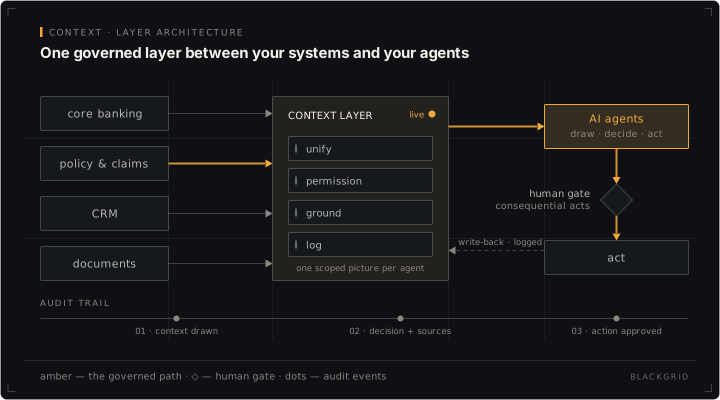
A context layer is the governed layer that sits between an organization's systems of record and its AI agents. It does four jobs at once: it unifies fragmented data into one current picture, permissions what each agent and person is allowed to see, grounds every answer and action in that trusted context, and logs what each agent saw and did. Models keep getting better; what decides whether agents work in production is whether they get the right context, with the right controls, every time. The context layer is the piece of architecture that makes that true.
Why agents fail without one
Enterprise knowledge is fragmented across core systems, document stores, CRMs, wikis, and inboxes — and most of it never reaches the model at all, the dynamic we unpacked in the <1% problem. An agent that cannot reach the current policy, the latest claim note, or the customer's real history does what language models do under uncertainty: it guesses, fluently. In a consumer app that is an annoyance. In a bank or an insurer it is an unexplainable decision — and a system nobody will sign off to production.
The naive fix is point-to-point: each agent project wires itself to the systems it needs, builds its own retrieval, and bolts on logging at the end. That works for one pilot, then collapses at the second and third — every project re-solves permissions, freshness, and audit slightly differently, and no one can answer "what did this agent know when it acted?" across the fleet. Gartner expects more than 40% of agentic AI projects to be canceled by the end of 2027, and ungoverned, unrepeatable context plumbing is a large share of why.
The four jobs of a context layer
- Unify. Connect the systems of record once — core and transaction systems, policy and claims platforms, CRM, documents — and resolve them into one current, queryable picture, instead of N copies and exports.
- Permission. Enforce who and what may see each piece of context at retrieval time, so an agent acting for a claims adjuster sees exactly what that adjuster is entitled to see — no more.
- Ground. Give every agent its answers from retrieved, attributable sources — the discipline behind retrieval-augmented generation — so outputs carry citations rather than confidence alone.
- Log. Record what was retrieved, what the agent reasoned, what it did, and who approved it — the raw material of the audit trail regulators and model-risk teams expect.
How it relates to RAG, MCP, and the rest
The adjacent terms name parts; the context layer is the whole, operated as governed infrastructure:
| Term | What it is | Relation to the context layer |
|---|---|---|
| RAG | Retrieve-then-generate technique | One technique the layer operates, with permissions and logging around it |
| Agentic RAG | Retrieval as a reasoning loop | A smarter retrieval pattern inside the layer |
| MCP | Open protocol for tools & data | The standard wire; the layer governs what moves over it |
| Vector database | Semantic search store | A storage component within the layer |
| Context window | The model's working memory | The budget the layer fills with only what is relevant and permitted |
Context engineering, made infrastructure
Anthropic's engineering guidance on effective context engineering frames the craft well: a model's context window is a finite resource, and agent quality depends on curating the smallest set of high-signal information that fits. That curation cannot stay a per-prompt craft when dozens of agents run against dozens of systems. A context layer is context engineering operationalized — the curation, scoping, and freshness decisions implemented once, governed centrally, and applied to every agent the same way.
Why it matters most in regulated industries
For banks and insurers, context is the constraint — the central argument of agentic AI in financial services. Every consequential workflow demands the same three proofs: the agent acted on current, permitted data; its decision can be explained; and a person held the checkpoint on actions that mattered. Bolting those onto each project after the fact is how pilots stall. Designing them into the layer that feeds every agent is how they ship.
A context layer is not another model to buy — it is the part of the stack that makes whichever models you use defensible. Talk to BlackGrid about standing one up on the systems you already run.