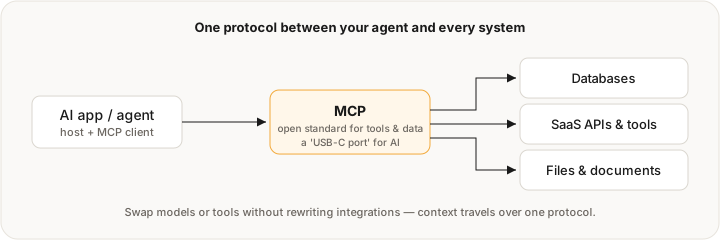
The Model Context Protocol (MCP) is an open standard that lets an AI application connect to external tools and data through a single, consistent interface — instead of a custom integration for every system. Anthropic introduced MCP in November 2024, and its documentation describes it as "a USB-C port for AI applications": one connector that any compliant client can use to reach any compliant data source. For agentic systems this is foundational, because an agent is only as useful as the systems it can actually reach — and MCP is how it reaches them.
The problem MCP solves
Before a shared protocol, every connection between an AI application and a system was bespoke. Ten applications that each needed to reach ten systems implied up to a hundred separate integrations — each one built, secured, and maintained by hand, and each one breaking on its own schedule. That N×M problem is why so many promising agents never left the demo: the model was capable, but wiring it into the real estate of an enterprise was the actual work.
MCP collapses N×M into N+M. An application implements the protocol once and can then reach any system that exposes an MCP server; a system implements one server and becomes reachable by any MCP-compatible application. The integration stops being combinatorial — the trade-offs against calling each system directly are laid out in MCP vs API.
How MCP works
The protocol has three roles:
- Host and client. The AI application (the host) embeds an MCP client that speaks the protocol.
- Servers. Lightweight programs expose capabilities to the client — tools (actions the agent can take), resources (data it can read), and prompts (reusable templates).
- A common message format. The client discovers what a server offers and invokes it the same way regardless of the system behind it, as set out in Anthropic's developer documentation.
The payoff is uniformity: an agent calls a CRM, a data warehouse, and an internal API through one interface, and a new capability is added by pointing it at another server — not by rewriting the agent.
MCP and RAG are complementary
It is easy to conflate MCP with retrieval. Retrieval-augmented generation (RAG) fetches relevant text and puts it in the model's context so the answer is grounded in real data. MCP is the connection layer underneath — the standardized way an agent reaches tools and data of any kind. In an agentic RAG system, MCP is frequently how the agent calls its retrieval step alongside its other tools. One grounds the answer; the other plumbs the connections.
What MCP is not
It helps to be precise about the boundaries. MCP is not a model, and it is not an agent framework — it is the wire between them and your systems. It does not provide authentication, authorization, or data governance; it standardizes the connection so your controls can live in one consistent place rather than being reinvented per integration. And it does not remove the work of building and securing a server for each system — it removes the work of building a different client for each one. Treat it as plumbing done right, not as a strategy in itself.
Why it matters for financial services
For a regulated institution, context is the constraint, not raw model capability — the central argument of agentic AI in financial services. A protocol that makes connecting to core systems uniform is therefore strategically useful: it shortens integration and reduces the bespoke surface area that has to be secured.
But standardization is not a free pass on governance. MCP standardizes the interface, not your controls. Authentication, least-privilege scoping, and logging every tool call to an audit trail remain your responsibility — and they become easier to apply consistently precisely because every connection speaks the same protocol. The same applies as systems grow: in multi-agent orchestration, several agents reach their tools over the same standard, and the highest-impact actions still pass through a human checkpoint before they execute.
A shared protocol is infrastructure, not strategy. It removes a class of integration toil so the harder problems — grounding, evaluation, and oversight — get the attention they deserve. Talk to BlackGrid about connecting agents to your systems safely.