In regulated finance, an AI decision you cannot reconstruct is a liability. Regulators, internal audit, and model-risk teams all expect the same thing: that any decision an AI system influenced can be explained after the fact — what data it used, which model version produced it, what rules applied, and what the human reviewer saw at the time. For an agent that acts across many steps, meeting that bar is harder than for a single-score model, and it is non-negotiable. Auditability is the backbone of every governable deployment described in agentic AI in financial services.
What regulators expect
The principle runs through US model-risk guidance — both the long-standing SR 11-7 and the revised OCC 2026-13, which (while placing agentic AI outside its scope) leaves the expectation intact: decisions must be traceable and reconstructable. The NIST AI RMF frames this under its Govern and Measure functions, and NYDFS extends it to third-party and vendor AI.
What an agent audit trail must capture
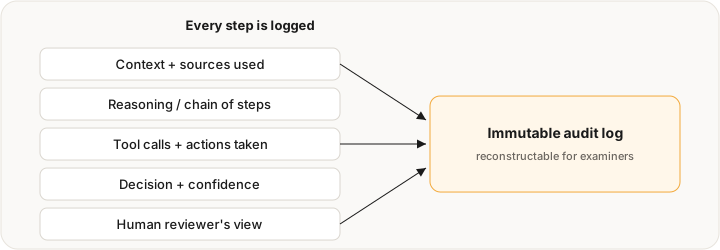
A production-grade trail logs, for every decision:
- Context and sources — exactly what the agent retrieved and used.
- Reasoning — the step sequence or chain that led to the action.
- Tool calls and actions — every external call and state change the agent made.
- Decision and confidence — the outcome and how sure the system was.
- Alternatives considered — what was weighed and rejected.
- Human checkpoints — what the reviewer saw and approved.
- Model and policy version — so a decision can be tied to the exact system that made it.
Why ephemeral context fails
Agents naturally use transient context and intermediate reasoning that disappears unless you capture it deliberately. A system that logs only the final output cannot answer "why did it act this way?" months later. That is why a governed agentic RAG layer — which records what was retrieved and used — and explicit action logging are foundational, not optional.
Audit trail vs. ordinary logging
Application logs and an audit trail are not the same thing, and conflating them is a common reason agentic projects fail their first audit. Ordinary logs are built for engineers debugging a system — verbose, mutable, and rotated on a short schedule. A decision-grade audit trail is built for a different reader (an examiner, an internal auditor, a model-risk reviewer) and is organized around decisions, not services. It has to reconstruct a specific outcome for a specific customer at a specific time: the inputs, the retrieved context, the reasoning, the action taken, the model and policy version, and the human sign-off. It is append-only, tamper-evident, and retained for years, not days. If your only record of why an agent declined an application is a debug log that rolled over last week, you do not have an audit trail.
Retention, integrity, and access
Three properties turn a log into evidence. Retention — records must outlive the applicable regulatory and limitation periods, which in lending and AML often means several years; set it deliberately rather than inheriting a logging default. Integrity — the trail should be tamper-evident, write-once or cryptographically chained, so a reviewer can trust that a record was not altered after the fact. Lineage and access — each entry should link to the exact model version, prompt, policy, and data sources behind the decision, and access to the trail itself should be controlled and logged. Done well, this is what lets an institution answer an examiner's question months later in minutes, instead of launching an investigation.
What a failing audit trail looks like
You can usually spot an un-auditable agent before an examiner does. The tells: the system records a final decision but not the intermediate reasoning; retrieved context is summarized rather than captured; tool calls are logged without their inputs and outputs; the human approval is a checkbox with no record of what the reviewer actually saw; and there is no stable link from a decision back to the model and policy version that produced it. Each gap is a place where why did the agent do this? has no answer — and closing them is the difference between an agent you can deploy and one that stays a demo.
The audit trail is also what makes AML/KYC closures defensible and explainable lending decisions provable. Build it in from day one, as part of your model risk management for agentic AI program — retrofitting it after a pilot rarely works.
Talk to BlackGrid about making your agents auditable by construction.