In lending, explainability is not a best practice you adopt when convenient — it is the law. When an AI system contributes to denying credit, the lender must be able to state the specific principal reasons, in terms a consumer can understand. That obligation does not disappear because the decision ran through an agent. It is the single hardest constraint on agentic AI in banking credit workflows, and getting it right is what separates a deployable underwriting agent from a compliance incident.
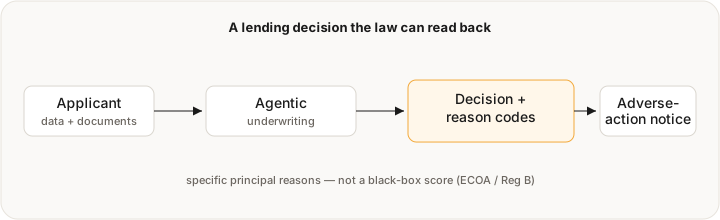
Explainability is already the law
Two regimes make this concrete:
- ECOA and Regulation B (US). A creditor must provide an adverse-action notice with specific, accurate principal reasons for a denial. CFPB Circular 2022-03 confirms these requirements apply even when the decision is based on a complex algorithm, and that a creditor's inability to explain its own model is not a cognizable defense.
- GDPR Article 22 (EU). GDPR Article 22 gives individuals the right not to be subject to solely automated decisions with legal or similarly significant effects, with safeguards including human intervention and the right to contest.
A black-box score that no one can decompose into reasons fails both.
What this means for an agentic underwriter
An agent that pulls bureau data, verifies documents, applies policy, and recommends a decision must carry the reasons alongside the outcome — reason codes tied to the features and rules that drove it, not a post-hoc rationalization. That is a design requirement, not a reporting afterthought: the explanation has to reflect what the system actually did.
How to build it in
- Interpretable decision logic or reliable reason-code generation at the point of decision.
- Log the evidence — the features, documents, and policy rules behind each outcome.
- Human-in-the-loop for denials and edge cases.
- A full audit trail so any decision can be reconstructed and explained later — see what an AI agent audit trail must capture.
Global vs. local explanations
Explainability comes in two flavors, and lending needs both. A global explanation describes how a model behaves overall — which features matter across the whole portfolio — which is useful for validation and fair-lending review. A local explanation describes a single decision: why this applicant was declined. Adverse-action law is fundamentally about local explanations — the specific principal reasons for an individual outcome — so an agentic underwriter has to produce instance-level reasons, not just a feature-importance chart. Techniques such as reason codes and per-decision attribution (often built on methods like SHAP) exist to bridge the gap, but the discipline is the point: the reasons you disclose must reflect the features and rules that actually drove the decision, not a plausible story assembled afterward.
A practical explainability checklist
Building a lending agent you can defend comes down to a repeatable set of controls:
- Choose interpretable logic or a reliable reason-code layer — favor models whose decisions decompose cleanly, or constrain them (for example, monotonic constraints) so reasons stay sensible.
- Capture the evidence behind every decision: the features, documents, bureau data, and policy rules.
- Test for disparate impact — run fair-lending analysis across protected classes before and after deployment; an unexplained model is also an untested one.
- Keep a human in the loop for denials and edge cases, with the review recorded.
- Retain a full audit trail so any decision can be reconstructed for the applicant or an examiner.
- Generate the consumer notice from the same reasons the system used — not a separate, generic template.
- Re-check explanations as the model drifts — reasons that were accurate at launch can decay as data and behavior shift, so fold explanation quality into ongoing monitoring.
Explainability also sits inside the broader governance picture: with US model-risk guidance now excluding agentic AI (OCC 2026-13), institutions lean on frameworks like the NIST AI RMF and a deliberate program — see model risk management for agentic AI.
An underwriting agent you can stand behind is one whose every decision can be explained to the applicant and the examiner. Talk to BlackGrid about building that in.