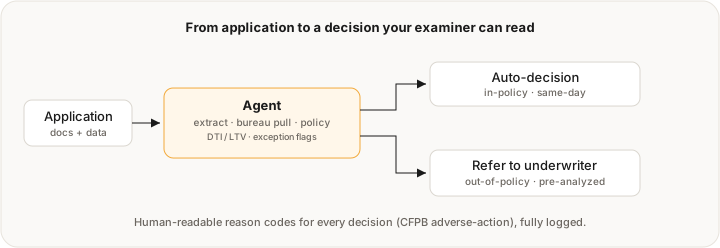
Agentic AI for credit underwriting coordinates the whole loan-processing workflow — not just the credit score. The agent extracts documents, pulls bureau data, runs policy checks, calculates ratios like debt-to-income (DTI) and loan-to-value (LTV), flags exceptions, and produces a recommendation: an auto-decision for clearly in-policy files, or a referral to a human underwriter — with the analysis already assembled — for everything else. It is one of the highest-value workflows in agentic AI in banking, and one of the most tightly regulated.
The workflow, not the score
Credit scoring is a solved input. The time and cost in lending live in the surrounding workflow: collecting and reading documents, pulling and reconciling bureau data, applying policy, computing ratios, and writing the credit memo. An agentic system orchestrates those steps end-to-end, often grounding its document understanding in vision or extraction models and verifying every input against source data. McKinsey highlights turnaround time as the headline metric: multi-day manual files compress toward same-day decisions for in-policy applications, while out-of-policy files reach an underwriter pre-analyzed.
What an underwriting agent actually touches
The capability that matters in underwriting is rarely the model — it is integration. A production agent has to reach the loan origination system to read and update the file; the credit bureaus for scores and tradelines; document and OCR services to extract income, asset, and identity data from PDFs and images; verification sources for employment and bank data; the policy or rules engine that encodes the institution's credit box; and a pricing engine for rate and terms. Each connection has to be permissioned, logged, and reliable, because the agent is now writing to systems of record, not just reading from them. This is why underwriting pilots that demo well so often stall on the way to production: the reasoning was never the bottleneck — the read/write access to core systems, and the governance sign-off to grant it, is the real project. A standard integration layer such as the Model Context Protocol shrinks that surface area, but the discipline of permissioning and logging every action stays with the institution, not the model.
Where automation stops: explainability
Lending is a consumer-protection minefield, and this is where agentic underwriting must be designed carefully. In the US, CFPB Circular 2022-03 is explicit: adverse-action notice requirements under ECOA and Regulation B apply even when a decision is based on a complex algorithm, and a lender's inability to explain its own model is not a defense. In the EU, the EU AI Act classifies creditworthiness assessment and credit scoring of individuals as high-risk, adding transparency and human-oversight obligations.
The practical implication: any agent in the credit-decision path must produce human-readable reason codes, not just a score — exactly the discipline of explainable AI in lending. Declinations and pricing have to be explainable and testable for bias.
In-policy decisions, human-led referrals
The deployable pattern is a clean split. Clearly in-policy, low-risk applications can be auto-decided where the action is reversible or auditable and the reasons are explainable. Anything out-of-policy, high-value, or novel is referred to a human underwriter with the agent's analysis pre-populated — fast, but human-owned. That boundary is a human-in-the-loop design choice, calibrated with evaluation data and widened only as confidence grows.
Controls and governance
Credit underwriting acts on a regulated decision, so it carries the full governance load: a complete audit trail tying each decision to the model and policy version, validation of non-deterministic behavior under model risk management for agentic AI, and fair-lending testing. Skipping these is the fast path to the cancellation column — Gartner expects more than 40% of agentic AI projects to be canceled by the end of 2027, often for inadequate controls. The same underwriting discipline carries over to its insurance cousin, agentic AI for insurance underwriting: different data and rules, but the same non-negotiable constraint that every decision be explainable, testable for bias, and logged.
Talk to BlackGrid about underwriting automation that is fast and defensible.