Agentic AI for insurance underwriting enables straight-through processing (STP): handling a submission from intake to a priced indication or bind without manual touchpoints, for risks that sit within appetite. The agent ingests the submission, enriches it with third-party data, applies underwriting rules, prices the risk, and refers only the complex or non-standard cases to an underwriter. It is the underwriting half of agentic AI in insurance — and, like its banking counterpart credit underwriting, it lives or dies on explainability and fairness.
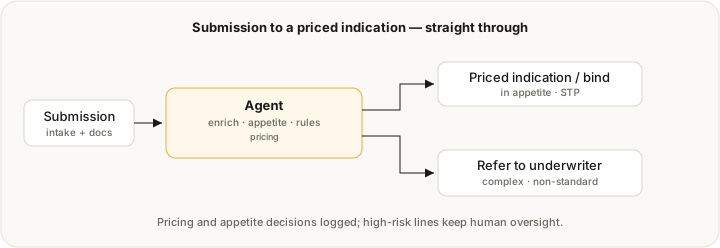
From submission to priced indication
The underwriting workflow has long involved multiple handoffs — intake, data enrichment, risk assessment, pricing, bind. An agentic system runs it as one flow: it reads the submission and supplemental documents, enriches with external data sources, checks the risk against appetite and underwriting rules, and outputs either a priced indication for in-appetite risks or a referred file for the underwriter. The result is fewer manual touchpoints and faster quotes on standard business, with scarce underwriting expertise reserved for the risks that need it.
Where STP stops
Straight-through is for in-appetite, standard risks. Complex, high-limit, or non-standard risks stay human-led — the agent prepares the file, the underwriter decides. Insurers widen the STP boundary as evaluation builds evidence that the agent prices a class of risk reliably, rather than maximizing automation on day one. Over-reaching is a common failure mode: Gartner predicts more than 40% of agentic AI projects will be canceled by the end of 2027, often for inadequate controls or unclear value.
The data behind a straight-through quote
How much underwriting an agent can do straight through is mostly a function of the data it can reach. A good agent enriches a submission with the third-party signals an underwriter would otherwise gather by hand: firmographics and business registries for commercial risks; property, peril, and catastrophe data for property lines; motor-vehicle and prior-claims history for auto; and financials where credit exposure is involved. The richer and more reliable that enrichment, the more of the book the agent can price without a referral — and the narrower the band of risks that need a human. Thin or low-quality data is what forces referrals, so the enrichment layer, not the model, usually sets the real STP rate.
Why the line of business changes everything
Not all underwriting is equally automatable. High-volume, well-understood lines — personal auto, small-business property — are natural homes for straight-through processing because the risks are standard and the data is plentiful. Complex commercial risks, high limits, and specialty lines stay human-led, with the agent preparing the file rather than pricing it. Life and health sit in a category of their own: under the EU AI Act their risk assessment and pricing are classified high-risk, which keeps a heavier human hand on the wheel regardless of how capable the agent becomes. The right STP target is therefore set line by line, not as a single number for the whole book.
What regulators expect
Underwriting decides who gets coverage and at what price, so fairness is the central obligation. In the EU, the EU AI Act classifies risk assessment and pricing in life and health insurance as high-risk, triggering transparency, documentation, and human-oversight obligations (the Act's high-risk compliance deadlines are subject to a proposed deferral that is not yet final law — confirm the current position with counsel). In the US, the NAIC AI Model Bulletin, adopted in December 2023 and taken up by a growing number of states, sets expectations on governance, accountability, and testing for unfair discrimination. McKinsey frames trust as the gating factor for the agentic era — and pricing that cannot be explained erodes it fast.
Controls: oversight, audit, and bias testing
Deployable underwriting automation keeps three controls non-negotiable: declinations and pricing must be explainable and testable for bias; high-risk lines retain a human-in-the-loop checkpoint; and every appetite and pricing decision is logged under a model risk management program built for non-deterministic systems. Get those right and STP is an accelerant; skip them and it is a compliance liability.
Talk to BlackGrid about straight-through underwriting that stays fair and auditable.