Agentic AI in insurance means software that works across the policy lifecycle — taking a claim from first notice of loss to a settlement recommendation, or a submission from intake to a priced indication — rather than just scoring or routing it. It is the insurance-specific form of the broader pattern described in agentic AI in financial services, and it lands first in the workflows that dominate an insurer's cost base: claims and underwriting.
Where insurers are applying it
- Underwriting and straight-through processing (STP). The agent ingests a submission, enriches it with third-party data, applies underwriting rules, and outputs a priced indication or a referred file — without manual handoffs for in-appetite risks. Complex and non-standard risks stay human-led.
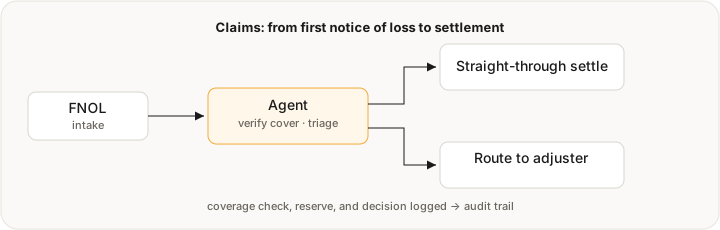
- Claims, FNOL to settlement. An agentic system handles intake across channels, extracts structured data from unstructured descriptions, verifies coverage against the policy, sets a reserve, and either initiates settlement for simple losses or triggers an investigation workflow.
- Claims fraud detection. Beyond scoring, the agent cross-references related claims and claimants, pulls third-party intelligence and imagery, and assembles an investigation package for a special investigations unit.
- Policy servicing. Endorsements, cancellations, renewals, and certificate issuance — high-volume, low-complexity transactions well-suited to supervised automation.
The pressure to deploy is real: Gartner forecasts that 40% of enterprise applications will feature task-specific AI agents by the end of 2026. Specific STP and claims-automation rates circulated by vendors vary widely and should be treated as directional until independently benchmarked.
What makes insurance different
Insurance decisions are consequential and regulated, so autonomy comes with constraints.
- Regulation. The EU AI Act classifies risk assessment and pricing in life and health insurance as high-risk, triggering transparency and human-oversight obligations (property-and-casualty may be captured only via other provisions). In the US, state insurance regulators and the NAIC AI Model Bulletin set expectations on governance, accountability, and unfair-discrimination testing — see US AI regulation for financial services.
- Explainability and fairness. Declinations, pricing, and adverse actions must be explainable and testable for bias — a black-box model is a compliance liability, the same dynamic that governs agentic AI in banking.
- Model risk and auditability. Validating non-deterministic agents, and logging every decision and source, is the hard part — see model risk management for agentic AI. Most production systems ground their reasoning in current policy and claim data via agentic RAG rather than stale model weights.
Where insurers should start — and how to widen
The winning pattern in insurance mirrors banking: begin where volume is high and a human is already in the loop, and expand autonomy only as the evidence justifies it. In claims, that means FNOL intake and triage — the agent captures the loss, extracts the details, and recommends a path, while an adjuster owns anything disputed or complex. In underwriting, it means submission intake and enrichment, with the agent assembling a priced indication that an underwriter approves until straight-through processing has earned trust on a class of risk. Lines carry different risk weights: personal auto and simple property losses are natural early candidates, while life and health — classified high-risk for pricing under the EU AI Act — keep a heavier human hand. Treat each expansion of autonomy as a decision backed by evaluation and monitoring, not a default. Start narrow, prove it, widen by exception.
From pilot to production
The same discipline that separates demos from deployments elsewhere applies here. Gartner predicts that more than 40% of agentic AI projects will be canceled by the end of 2027 — usually for escalating costs, unclear value, or inadequate controls. McKinsey frames 2026 as the shift to the agentic era, with trust as the gating factor. The insurers that succeed start narrow, keep a human on consequential decisions, instrument everything, and treat governance as a first-class deliverable.
Putting an agent into a regulated insurance workflow you can stand behind is mostly a governance and integration problem, not a model one. The carriers that pull ahead treat oversight and auditability as features of the product, not friction to be minimized. The BlackGrid solution for insurance shows what that looks like — or talk to BlackGrid about doing it safely.