Agentic AI for claims processing takes a claim from first notice of loss (FNOL) to a settlement recommendation — extracting the claim, verifying coverage, setting a reserve, and then either settling simple losses straight through, routing complex or disputed claims to an adjuster, or referring suspected fraud to the special investigations unit (SIU). Claims is the most heavily automated function in insurance and the leading area for agentic deployment, as covered in agentic AI in insurance.
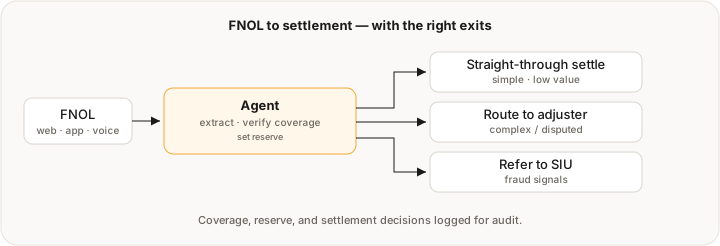
The claims workflow, automated
A claim is a multi-step process that has historically passed through several hands. An agentic system compresses it:
- Intake (FNOL). Capture the loss across channels — web, app, voice — and extract structured data from unstructured descriptions and documents.
- Coverage verification. Check the loss against the policy: is it covered, what are the limits, deductibles, and exclusions?
- Reserving. Set an initial reserve based on the loss characteristics.
- Disposition. Settle simple, low-value losses straight through; route complex, disputed, or large losses to an adjuster; refer claims with fraud indicators to the SIU.
The agent assembles and recommends; a human owns the consequential or contested calls. McKinsey frames 2026 as the shift to the agentic era, with trust as the gating factor — and nowhere is policyholder trust more visible than in how a claim is handled.
Straight-through, carefully
For low-complexity, high-frequency losses — minor auto, simple property — end-to-end automation to payment is technically achievable. The open question is rarely capability; it is governance and policyholder fairness. Settling automatically means the system has verified coverage correctly, priced the loss fairly, communicated clearly, and can show its work if challenged. The right starting point is FNOL intake and triage, where volume is high and a human is already reviewing, then widening straight-through settlement as evaluation builds confidence — not automating everything at once. Gartner predicts more than 40% of agentic AI projects will be canceled by the end of 2027, and over-reaching on autonomy is a reliable way to join them.
Where claims automation actually gets hard
The FNOL-to-settlement diagram looks clean; the difficulty is in the judgment-heavy middle. Coverage verification is rarely a simple lookup — policies carry endorsements, exclusions, and sub-limits, and getting the determination wrong is both a financial and a regulatory error. Reserving asks the agent to estimate ultimate cost from incomplete early information; set it too low and the insurer is under-reserved, too high and capital is tied up needlessly. Policyholder communication is part of the product: an automated denial or a lowball settlement a customer cannot understand erodes trust and invites complaints — exactly what unfair-claims-practices law polices. None of these are reasons not to automate; they are reasons to keep a human on the contested and complex claims, to ground the agent in the actual policy language via agentic RAG, and to log every coverage and reserve decision so it can be explained later. The straightforward, high-frequency losses automate well — the discipline is knowing where "straightforward" ends.
What insurance regulation requires
Claims handling is governed whether or not AI is involved. In the US, the NAIC AI Model Bulletin — adopted in December 2023 and taken up by a growing number of states — sets expectations on AI governance, accountability, and testing for unfair discrimination, layered on top of existing unfair-claims-settlement-practices law. In the EU, the EU AI Act attaches its high-risk obligations principally to risk assessment and pricing in life and health insurance, but the transparency and oversight expectations inform claims practice too.
Meeting that bar comes down to the same controls that govern every regulated agent: a complete audit trail of coverage, reserve, and settlement decisions, and a human-in-the-loop checkpoint for disputed and complex claims. The same discipline runs through its sibling workflow, agentic AI for insurance underwriting — and it is what turns claims automation from a pure cost play into a way to build, rather than erode, policyholder trust.
Talk to BlackGrid about automating claims without sacrificing fairness or auditability.