On April 15, 2026, BlackGrid founder Evgeny Aleksandrov, CFA, sat down with Delpha DiGiacomo of Zurich North America for an International Association of Special Investigation Units (IASIU) members' webinar, hosted by Geoff Keah, to unpack what is actually happening as agentic AI moves into the Special Investigation Unit (SIU) workflow — not the hype, but the reality at the desktop.
Fraud does not wait, and neither can the teams chasing it. The session was deliberately practitioner-led: how the tools are used day to day, where they fit into an existing SIU workflow, and how to avoid the common pitfalls — with one clear throughline. The goal is not to automate the analyst. It is to empower them.
Here are the takeaways worth carrying back to your team.
Empower the investigator — do not automate them
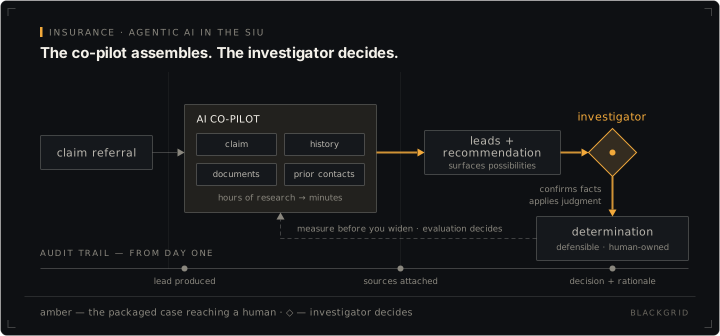
The most successful deployments treat AI as a co-pilot that compresses hours of manual research into minutes. That time goes straight back to the investigator, freeing them to do what only they can do: apply judgment, build cases, and close investigations with confidence.
This is the same pattern we see across agentic AI in financial services — the agent assembles the picture and recommends; the human decides. In SIU it is especially stark, because the output of the work is not a score. It is a defensible determination about a real person's claim.
Workflow fit beats model sophistication
The tools that stick are the ones that meet investigators where they already work — not the ones that demand a brand-new process built around them. An assistant that lives inside the existing case file earns adoption; one that asks an investigator to leave their system, re-key information, and learn a parallel workflow does not, no matter how capable the underlying model is.
That is why we think the hard problem is rarely the model. It is the context layer that lets an agent see a case the way an investigator does — the claim, the history, the documents, the prior contacts — and act on it where the work already happens.
Human-in-the-loop is non-negotiable
Agentic AI in SIU is not "set it and forget it." Every output, every lead, every recommendation runs through an experienced investigator — full stop. That oversight is not a limitation of the technology; it is what makes the technology trustworthy, defensible, and effective in a regulated, high-stakes environment.
It is also what the rules require. In insurance, adverse-action and anti-discrimination obligations mean a human has to own consequential decisions — a theme that runs through agentic AI in insurance, claims processing, and fraud detection. Human oversight is the design principle that makes all three safe to ship; we go deeper on it in keeping a human in the loop.
The pitfalls are real — and avoidable
Delpha and Evgeny walked through what has worked, what has not, and the guardrails every SIU team should have in place before scaling:
- Start where a human is already in the loop. Augment the research and triage investigators do today before automating anything end to end.
- Instrument an audit trail from day one. If you cannot show how a lead was produced, you cannot defend it — and you cannot improve it.
- Treat explainability as a requirement, not a nice-to-have. An investigator has to understand a recommendation well enough to stand behind it.
- Measure before you widen. Let evaluation, not enthusiasm, decide where automation expands.
- Do not over-trust the output. The model surfaces possibilities; the investigator confirms facts.
None of these are exotic. They are the difference between a pilot that scales and one that quietly gets shelved.
Why this matters beyond the SIU desktop
The SIU desktop is a microcosm of where agentic AI is heading across regulated finance: high stakes, real accountability, and a human who has to answer for the outcome. The teams getting it right are not the ones with the flashiest model — they are the ones who made the work auditable, kept a person accountable, and fit the tool to the workflow.
That is the premise behind BlackGrid: a unified context layer that gives agents the trustworthy, auditable grounding regulated teams need. If you are weighing where agentic AI fits in your SIU or claims operation, we would love to compare notes.
About the session
The webinar, "Agentic AI in SIU: Lessons Learned and What Investigators Need to Know," was presented to IASIU members in April 2026.
Evgeny Aleksandrov, CFA is the founder of BlackGrid and a thought leader on AI in insurance. He leads the Tech & AI sub-task force at the Coalition Against Insurance Fraud and is an Adjunct Professor at Columbia University. A repeat entrepreneur, he previously founded the insurtech Pilotbird; earlier, he advised financial-services clients on business transformation, investments, and M&A at McKinsey & Company, Goldman Sachs, and J.P. Morgan. He holds master's degrees from the London School of Economics and Columbia University and a bachelor's from Cornell University.
Delpha DiGiacomo is a distinguished insurance professional with more than 22 years in property and casualty. She leads Zurich North America's Claim Investigative Services and chairs the Coalition Against Insurance Fraud's Government Affairs Committee, where she advocates for integrity and transparency across the industry. Over her career she has held roles including Chief Accountability Officer, Assistant Vice President of Strategy and Operations, and Investigative Services Director — leading underwriting and claims investigations and building operational processes for digital agencies. She is also a sought-after speaker and author on leadership and inclusion.
With thanks to Delpha for the candor and insight, to Geoff Keah and IASIU for hosting, and to everyone who joined live and brought such sharp questions to the discussion.
Watch the full session
Watch the recording on YouTube →, or use the player above.