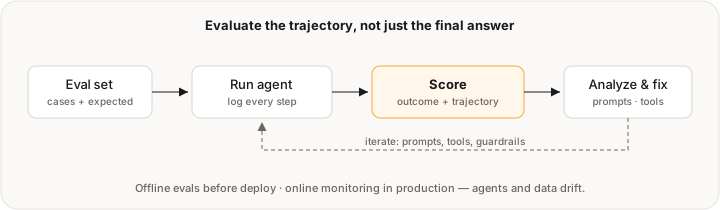
Evaluating an AI agent means scoring far more than its final answer. Because an agent reasons, calls tools, and acts across multiple steps, its evaluation has to cover the whole trajectory — the sequence of decisions and actions — not just the output at the end. You do this with a curated eval set run offline before deployment, and with sampled, monitored runs online in production. Evaluation is not a phase you finish; it is the discipline that decides whether an agent is ever fit to ship.
Why outcome-only testing fails for agents
A traditional model produces one output you can grade against a label. An agent can reach a correct-looking answer through a broken process — calling the wrong tool, inventing a parameter, taking an unsafe shortcut that happens to work on the test case and fails in production. It can also reach a reasonable answer the right way but cost ten times the tokens it should. Grading only the destination misses both. The research that popularized interleaving reasoning with action, ReAct, is a reminder that the steps are first-class behavior — which means the steps are first-class evaluation targets.
Offline and online — you need both
- Offline evals run a fixed set of cases with expected behavior before each release. They let you compare versions, catch regressions, and refuse to ship a change that makes things worse. This is the version-controlled backbone of the practice.
- Online evals sample real production traffic and score it, because live inputs always surface edge cases your test set did not imagine — and because agents and the data around them drift; fold what they catch back into the eval set. The NIST AI Risk Management Framework makes this continuous posture explicit in its Measure function: measurement is ongoing, not a one-time gate.
The metrics that matter
The mix depends on the use case and its risk, but most agent evaluations weigh some combination of:
- Outcome accuracy — did it achieve the task?
- Trajectory quality — were the steps sensible, and did it call the right tools with the right arguments?
- Tool-call correctness — did each action do what it claimed?
- Cost and latency — at what token and time budget?
- Safety and policy adherence — did it stay within the rules, every time?
Grading at scale: LLM-as-judge
Hand-scoring every trajectory does not scale, so teams increasingly use a model to grade another model's work against a rubric — the "LLM-as-judge" pattern. Done well, it makes broad, frequent evaluation affordable. Done carelessly, it launders bias: judges can favor verbose or familiar-looking answers, and a judge that shares the system's blind spots will miss them. The guardrails are to anchor the judge to a clear rubric, validate its scores against a human-labeled sample, and reserve human review for the high-stakes and the borderline. The judge widens your coverage; it does not replace your judgment.
Make evaluation a loop
The strongest pattern is to close the loop: run, score, analyze failures, fix prompts, tools, or guardrails, and run again. Anthropic's Building Effective Agents formalizes a version of this as the evaluator-optimizer pattern — one component produces, another critiques against criteria, and the cycle repeats until a bar is met. The same loop, applied to your own eval set, is how an agent gets measurably better instead of anecdotally better.
This discipline is also what makes agents survive contact with reality. Gartner predicts that more than 40% of agentic AI projects will be canceled by the end of 2027, frequently for unclear value and inadequate controls — both of which evaluation directly addresses.
In regulated settings, evaluation is governance
In agentic AI in financial services, evaluation is not just an engineering nicety — it is how you validate a non-deterministic system, the core demand of model risk management for agentic AI. It is also what lets you calibrate where a human-in-the-loop checkpoint belongs and how widely to automate, and it tightens as systems grow into multi-agent orchestration or ground themselves with agentic RAG.
You cannot govern what you cannot measure. Talk to BlackGrid about building the evaluation harness your agents need before they reach production.