Anti-money-laundering (AML) and know-your-customer (KYC) compliance is one of the highest-cost, lowest-signal workflows in any large bank — and one of the clearest early wins for agentic AI. The reason is structural: the majority of alerts generated by transaction-monitoring rules close as false positives after manual review, so most analyst time goes to clearing noise. Agentic AI attacks that directly, automating the triage layer while keeping a human accountable for every consequential decision. It is the compliance-side counterpart to the use cases in agentic AI in banking.
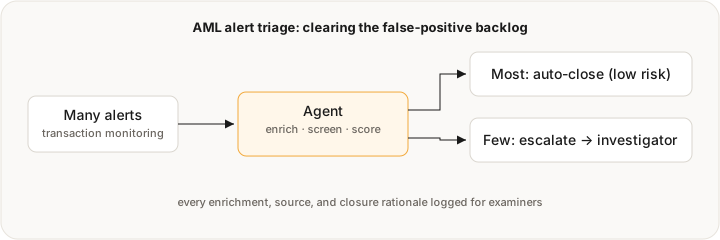
Where agentic AI fits in AML/KYC
- Alert triage and case closure. The agent enriches each alert with customer history, counterparty and sanctions screening, and typology matching, scores it for priority, and drafts a closure rationale for clearly low-risk cases.
- Transaction screening. Continuous monitoring with context-aware scoring, reducing the false-positive volume that swamps investigators.
- KYC onboarding and perpetual KYC. Document extraction, identity verification, beneficial-ownership resolution, and periodic refresh — a multi-step workflow an agent can coordinate end-to-end.
- SAR preparation. Assembling the evidence and drafting the suspicious-activity-report narrative for a human to review, refine, and file.
McKinsey describes this broader shift in banking operations as moving staff from rule-based execution toward judgment — exactly the move AML triage automation enables.
Why false positives dominate AML alerts
Rules-based transaction monitoring is deliberately conservative: thresholds and typologies are tuned to avoid missing real laundering, which means they also fire on a great deal of legitimate activity. The result is familiar to every compliance team — the large majority of alerts are false positives, and clearing them is slow, manual, and repetitive. Adding analysts scales the cost linearly and burns out skilled staff on low-value work. Agentic AI changes the unit economics: the agent does the gathering and contextualizing that consumes most of an investigator's time on a routine alert, so human attention concentrates on the alerts that actually carry risk. The point is not to lower the bar on detection — it is to spend scarce expertise where it matters most.
The governance is the hard part
In financial crime compliance, the controls are not optional overhead — they are the work.
- Audit trail. Every enrichment step, every data source consulted, and every closure rationale must be logged and attributable for regulator review. An agent that cannot show its work is not deployable.
- Model risk. Revised US guidance (OCC 2026-13 / SR 26-02) places generative and agentic AI outside the scope of the familiar model-risk process, so governance leans on the NIST AI RMF and a deliberate program — see model risk management for agentic AI.
- Vendor and security risk. NYDFS guidance sharpens expectations on third-party AI and data security for covered entities.
- Human accountability. Closure and escalation thresholds, and mandatory human sign-off on SARs, keep a qualified person in the decision loop.
Grounding the agent's reasoning in current policy, watchlists, and customer data — via agentic RAG rather than stale model weights — is what makes the triage both accurate and defensible.
What stays human
Automation in AML works only when the accountability lines are explicit. An agent can enrich an alert, score it, draft a closure rationale, and assemble a suspicious-activity-report (SAR) narrative — but the consequential calls remain a person's: closing a borderline case, escalating, and above all filing a SAR, which a qualified individual must own and sign. The same holds in KYC — an agent can resolve beneficial ownership and surface discrepancies, but accepting or exiting a high-risk relationship is a human judgment. Designing those checkpoints, and recording what the reviewer saw at each one, is what keeps the program defensible. It is the human-in-the-loop discipline applied to financial crime.
Start narrow, instrument everything
The deployments that reach production start where a human already reviews every case, prove the agent's recommendations against that baseline, and only then widen auto-closure. Treat evaluation and audit logging as day-one deliverables, not afterthoughts.
Talk to BlackGrid about deploying agentic AML/KYC with the audit trail and controls examiners expect.